There are times when I wish I didn’t write theatre reviews, not many I grant you, but this was one of them. Not because I thought that the play was bad, far from it, it was absolutely superb, ironically that was the problem. Instead of concentrating on the different elements which make up a great piece of theatre, I would have loved, just for once, to have sat back and lost myself in the show, and boy, was there plenty to lose yourself in.
The story is quite straightforward, recounting the experiences of a horse bought from its owner by the army for use on the front line in the First World War. It is basically split into two parts; the first growing up on a farm in Devon, the second in the thick of battle in France.

We begin at an auction in 1911 where local farmer, Ted Narracott, is watching a horse sale. He is in his usual drunken state and, instead of buying a working horse, gets into a bidding war with his landlord, Lyons, over a foal bred for riding. Determined not to back down he pays well over the odds, using up all the money put aside for the mortgage. This doesn’t go down well with his wife, Rose, who now has to cut back on the housekeeping. Their son, Albert, on the other hand, is delighted and soon bonds with the foal, which he names Joey, rearing him and becoming friends. At this point I thought that it was going to follow the well-trodden path of child and creature relationships we have seen many times before in works such as Kes, Black Beauty and even ET, but things soon took a sinister turn. After being ridiculed by his neighbours regarding the horse’s suitability for farm work, Ted, again the worse for drink, has a bet with them that it can draw a plough. In fact it can’t, but Albert coaxes it into doing so, more than recouping the buying price, and providing Joey with a skill which will come in useful later.
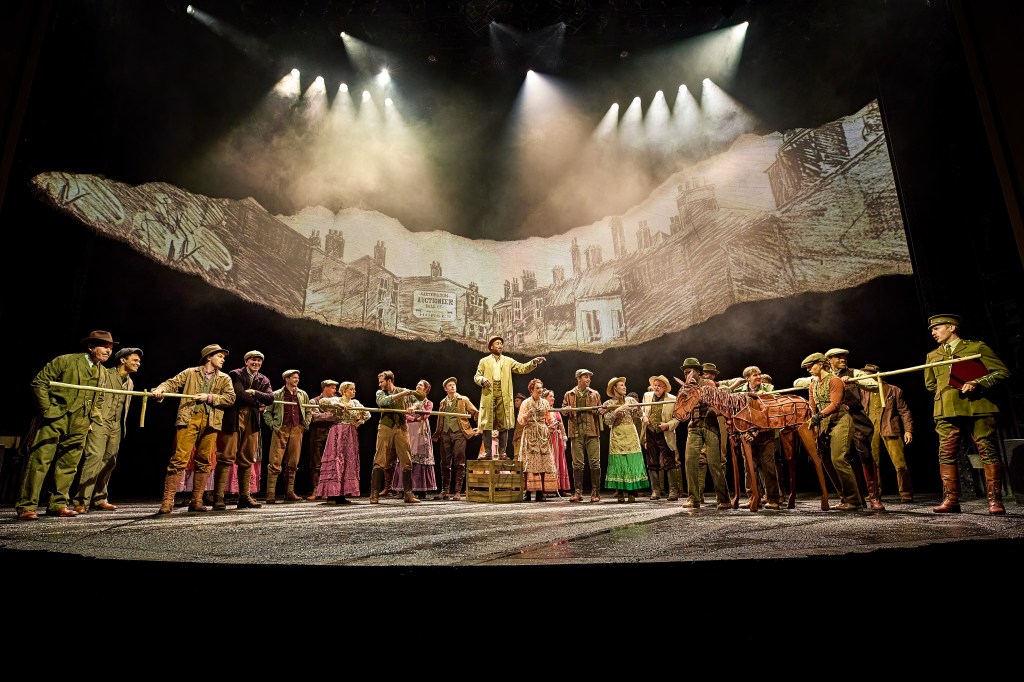
At the outbreak of war, the local Army Regiment search the area for horses to buy to serve on the French front, and Ted accepts £100, which Rose takes from him so that he doesn’t drink it away or squander it. Needless to say, Albert is bereft and tries to join the army so he can go with Joey, but, as he is only 15 he is rejected as the minimum age is 19. The officer who buys Joey is Captain James Nicholls, who, having seen the horse in the fields, has been sketching him. Undaunted, Albert runs away to a town where he is not known and lies about his age in order to join up. As Joey has already been posted, it means that he will have to search France for him.
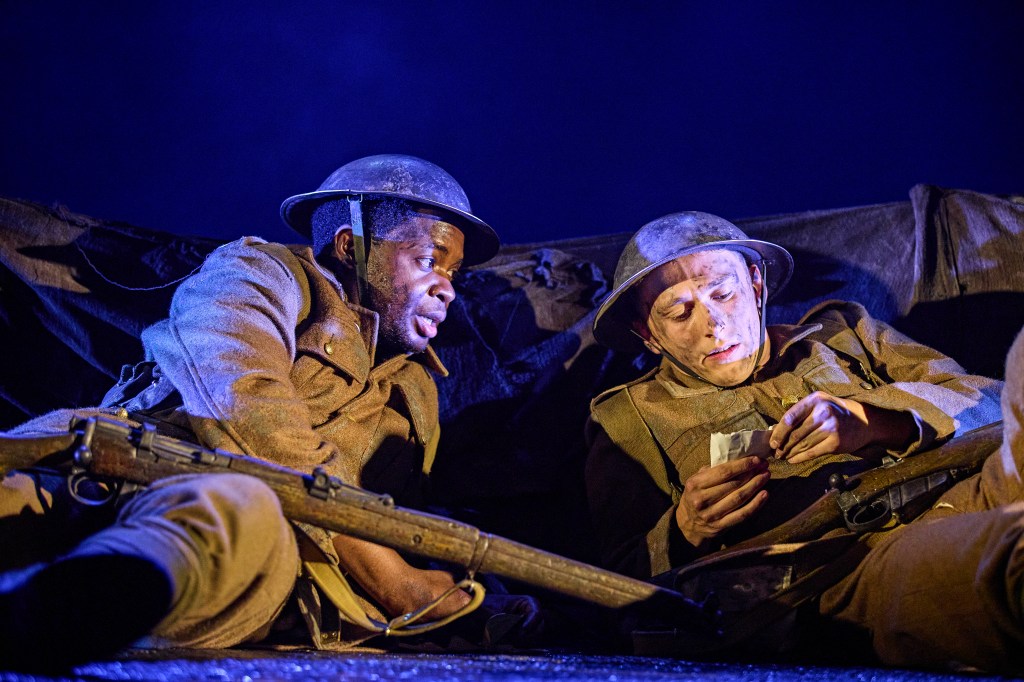
The scene shifts to the battlefields of northern France, where Joey has been stabled with Topthorn, the mount of Captain Jamie Stewart, and the two horses form a strong bond. In one charge against the German line, Nicholls is killed and Joey is assigned to Trooper Warren. The two riders take part in another charge and break through enemy lines, even though the rest of their unit has perished, but they are soon captured by the Germans. This is where the ploughing experience comes in, as, instead of being sent back into battle ridden by German officers, they are used to draw ambulance carts, thus escaping the worst of the danger. They are cared for on a farm by Emile and her mother, but, when the hospital moves on, the horses are used to pull artillery back on the front line. This proves too much for Topthorn, who dies. Joey becomes distressed and bolts into no-man’s-land where a unit of German and British soldiers race to extricate him from the barbed wire. When Joey is freed, a soldier from each side toss a coin to decide who will get to keep Joey. The British squaddie wins and he is taken to the local field hospital for treatment.
As luck would have it, Albert has been in the Battle of the Somme where he was overcome by tear gas, rendering him temporarily blind, so he too finds himself at the same facility. Although unable to see, he realises that there is a horse there, which he senses is Joey. He makes the call he used to use on the farm at home and, sure enough, the horse comes and nuzzles Albert’s head.
All ends well with Armistice being declared and the pair shipped home to Devon.
The story is only the half of it, the staging and special effects, being equally integral to the overall spectacle.
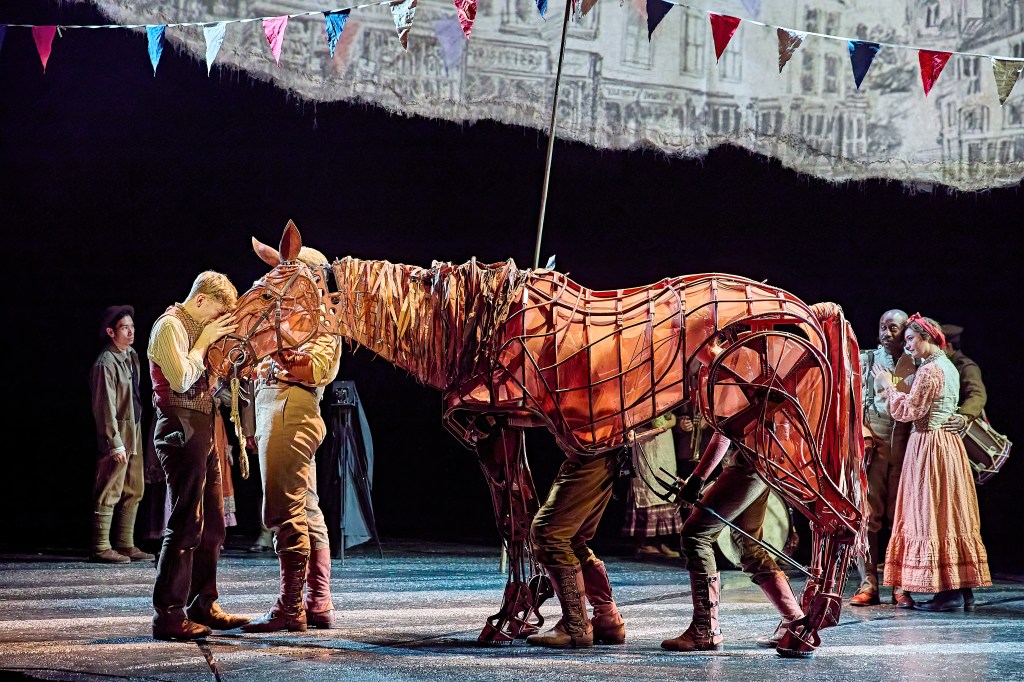
The horses, and a goose, are brought to life by puppets, which means that the audience is required to exercise their imagination a great deal. This enhances the experience as the same faculty is needed to picture everything from the rolling fields of rural Devon to the Battle of the Somme in all its horror. As it would be impossible to replicate either of these locations, or any of the others, in the confines of the stage at Leeds Grand Theatre, they don’t even try, but employ the principle that less equals more, so the space is left more or less bare throughout.
A door and window are used to represent both the farms in the story, and a roll of barbed wire unravelled to indicate the battlefield, but otherwise the mood is evoked by an inventive backdrop, comprising a black sheet with a white horizontal section in the middle, looking as though a part has been ripped out of it, on which various images are projected. This is done to great effect, especially in one scene, where a thunderstorm is duplicated by rainfall on the white part, with smoke rising over the top section making it look for all the world like heavy black clouds.
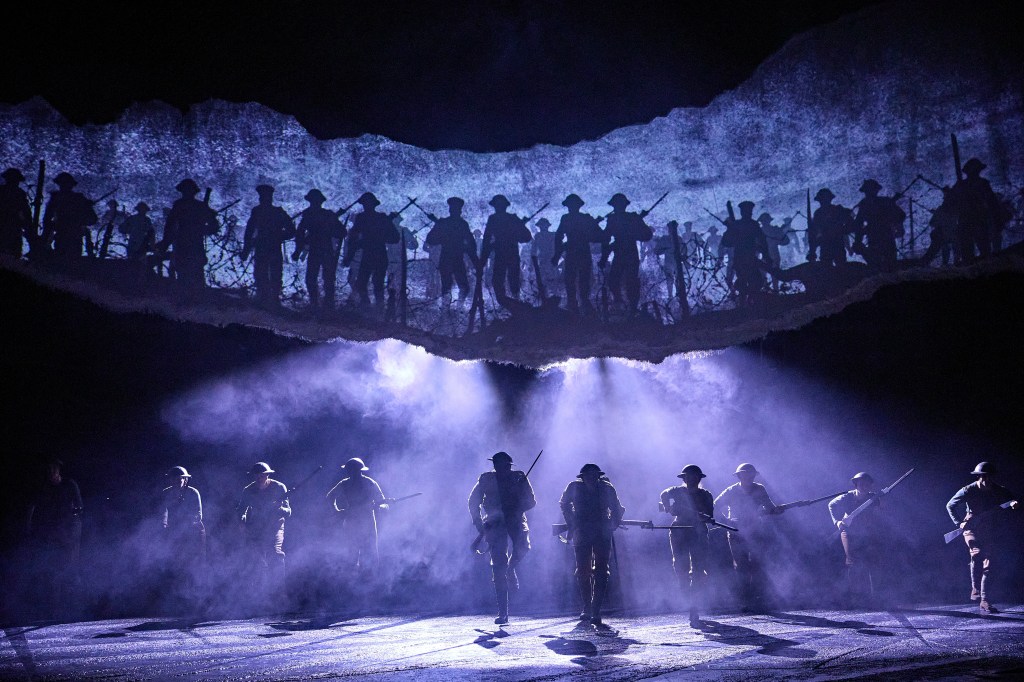
The acting was amazing, with several of the cast, not only portraying more than one character, but some doubling their parts with stints of puppetry. Going back to my introductory paragraph, I was mesmerised by the technical aspect and mechanics of the horses. Every part, although impressionistic, was perfectly made in order to suggest things like the trembling of the hind quarters when in pain or the random swish of the tail. There was a moment when Joey changes from being a young foal into a full grown animal, which was breathtaking. The timing, synchronisation and sheer strength of the operators, who, not only had to bear the structure, but also occasionally a rider, required the skills of a ballet dancer crossed with a weightlifter.

The special effects had us involved in every aspect of the story; on a couple of occasions the cast entered the stage via the auditorium and, on others, the lighting was trained on the main body of the theatre. The sound was also evocative in both the bucolic moments, and, more forcefully, in the battle scenes, where the vibrations from the noise of heavy artillery fire hit my chest like being at a Who gig.
Speaking of music, like the story and the backdrop, this was also divided into two sections, the first being live performances of songs of the time, performed by a folk singer who also played the accordion, sometimes backed by a choir, again populated by the actors not involved in that scene. The main soundtrack was orchestral and recorded.
I have deliberately refrained from naming any of the cast, because it would not be fair on the others as it was very much an ensemble piece. Having said that, the puppeteers operate on a rota basis and tonights crew were:
Joey as a foal – Head – Jordan Paris, Heart – Eloise Beaumont-Wood and Hind – Clara Lioe.
Joey – Head – Tom Quinn, Heart – Lewis McBean and Hind – Michael Larcombe.
Topthorn – Heart – Tea Poldervaart, Heart – Robin Hayward and Hind – Gun Suen.
This production was directed by Tom Morris with revival director, Katie Henry.
Should you wish to make a booking, find out more about the cast, creatives and tour dates, as well as seeing a trailer, please go to the on-line programme at https://www.warhorseonstage.com/ and navigate via the menu at the top of the page.
I can’t recommend this show highly enough, and, to back up my impression, even though there was no pre-performance warning against using mobile phones, I didn’t spot one audience member checking their device. In 2025, there can be no higher praise.
War Horse is at Leeds Grand Theatre until Saturday, 6th September, 2025 so please use the link above, or the one below to book.
To see what else is on at Leeds Heritage Theatres go to https://leedsheritagetheatres.com/whats-on/
Photographs by Brinkhoff-Moegenburg
 Tyke It To The Limit